
I. Basic Product Knowledge
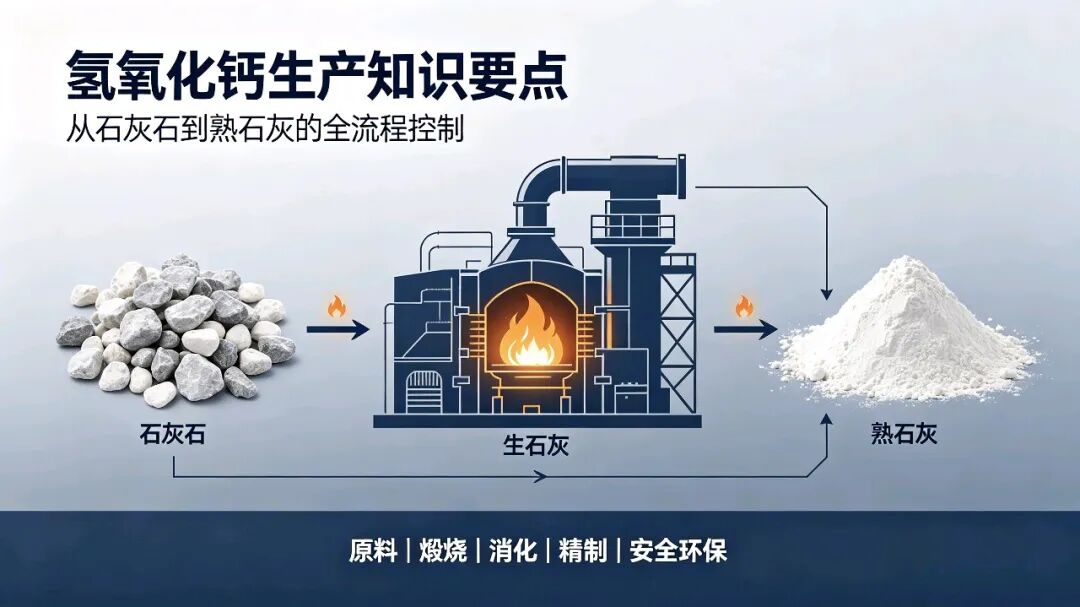
Calcium hydroxide, commonly known as quicklime or hydrated lime , has the chemical formula Ca(OH)₂ . It is produced industrially using a two-step process:
1. High-temperature calcination of limestone: CaCO₃ ( high temperature)⁼ CaO + CO₂↑ , producing quicklime (calcium oxide).
2. Hydration of quicklime with water: CaO + H₂O = Ca(OH)₂ . The industry standard for converting finished calcium hydroxide output
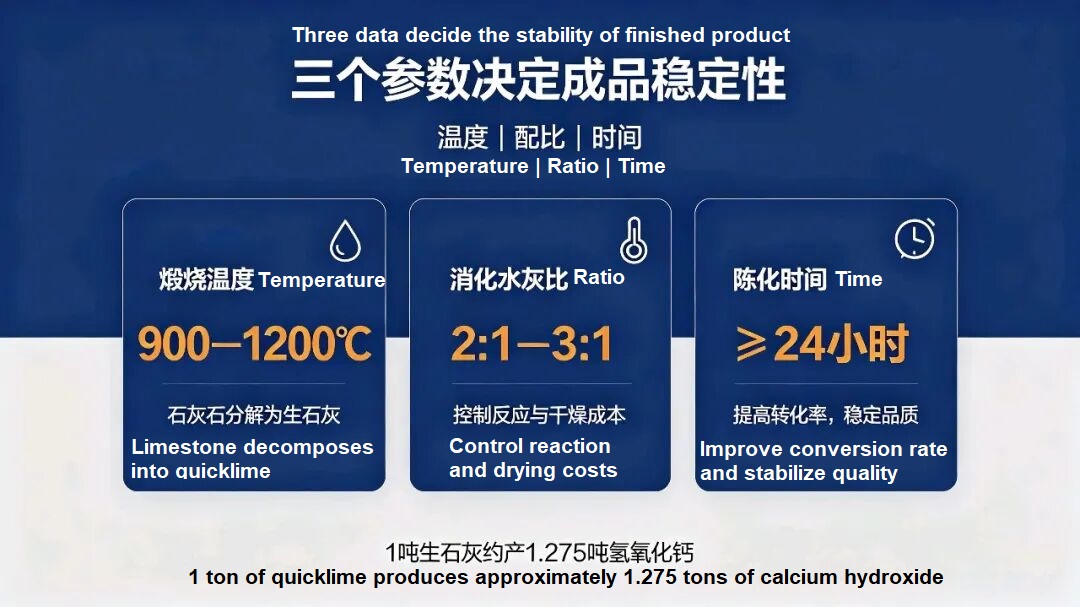
is: 1 ton of quicklime can stably produce 1.275 tons of calcium hydroxide.
II. Raw Material Selection: Determining the Upper Limit of Finished Product Quality.
Raw material control is the first hurdle in reducing impurities and defects. Practical standards are clear:
1. Limestone Quality Indicators:
Calcium carbonate content ≥90%, total impurities of magnesium oxide and silicon dioxide <2%; Magnesium oxide is the number one harmful impurity, producing slowly dissolving magnesium oxide during calcination, which easily causes cracking and volume instability in the finished product during storage. Procurement requires prior testing.
2. Particle Size Control:
Limestone particle size entering the kiln should be 20-50mm; excessively large pieces will not calcine thoroughly, forming "quick lime," while excessively small pieces will block the kiln air ducts, causing oxygen deficiency during combustion.
3. Fuel Selection:
Prioritize natural gas and low-sulfur raw coal. High-sulfur fuels will cause sulfides to mix into the product, reducing the quality of desulfurization and chemical materials.
III. Calcination Process: The calcination process is the most energy-intensive stage in the entire plant
, with calcination temperatures ranging from 900-1200℃. Fuel and electricity costs account for 35%-45% of the overall production cost. Three main types of kilns are selected according to needs:
1. Rotary Kiln: High thermal efficiency and large single-plant output, suitable for large-scale production lines with capacities of tens of thousands of tons.
2. Vertical Kiln: Simple equipment structure, small footprint, and low initial investment, the first choice for small and medium-sized lime plants.
3. Double-Chamber Kiln: Lowest energy consumption due to its regenerative design, but higher equipment investment costs, suitable for enterprises with long-term energy-saving plans.
Practical Tips: Equipped with a waste heat recovery device, the overall thermal efficiency of the kiln can be increased to over 85%, significantly reducing coal consumption.
IV. Processing Process: The core reaction for product formation
is the exothermic reaction between quicklime and water. There are two mature processes: dry and wet, which are matched to downstream customers as needed.
Comparison of Dry and Wet Processes:
| Items | Dry process | Wet process |
| Finished product | Dry powder hydrated lime | Lime milk slurry |
| Input & operation | Less investment & simple process flow | More program, dehydration and drying is required |
| Character | Rich pores and strong adsorption capacity | Higher purity and larger specific surface area |
| Suitable industries | Power plant flue gas desulfurization, building materials roadbed | Food chemical industry, high-end fine calcium products |
Three key control parameters:
1. Water-lime ratio: The mass ratio of quicklime to water is 2:1~3:1. Adding too much water increases the electricity cost of the subsequent drying process, while adding too little water results in incomplete digestion and excessive free calcium .
2. Digestion temperature: Stable at 60-80℃. The reaction is violent and exothermic; exceeding the temperature can cause material splashing and burns.
3. Aging time: After digestion, the material should be left to stand for ≥24 hours to achieve a quicklime conversion rate of over 90% and reduce residual calcium oxide.
V. Refining, screening, and finished product grading and packaging
1. Wet process: Digestion slurry → solid-liquid separation and dehydration → low-temperature drying → grading and screening
2. Dry process : Digestion powder is directly graded by air classification, eliminating the dehydration process
. Two finished product execution standards (purchasing and factory testing basis):
1. Industrial grade calcium hydroxide: Complies with HG/T 4120-2024, strictly controlling the content of free calcium oxide and magnesium oxide.
2. Food grade calcium hydroxide: Complies with GB 1886.375-2024, there are mandatory limits on heavy metals such as lead, arsenic, and mercury. Industrial-grade mixing is strictly prohibited.
Finished products in food processing settings should be packaged and sealed according to different fineness (mesh size) to prevent moisture absorption and carbonization.
VI. List of core equipment for the entire production line and key selection points:
| Production | Core equipment | Requirement |
| Raw material crushing | Jaw crusher | Hydraulic gap adjustment device, metal detector to avoid the damage of equipment |
| High temperature calcination | Rotary kiln/shaft kiln | Waste heat recycling system with heat efficiency no less than 85% |
| Digestion | Horizontal /double shaft mixer | With cooling & anti-caking mixing device, temperature controlling to prevent material spraying |
| Grinding & classification | Vertical roller mill /ball mill | VRM is better, saving 30% of energy comparing with that of ball mill |
| Dust collecting | Cyclone dust collector & pulse bag filter | Comprehensive dust collecting efficiency no less than 99.9% to mee the demands of super low exhaustion |
1. Heat-insulated guardrails are installed at digestion workstations; bare hands are strictly prohibited from contact with high-temperature materials throughout the process
2. Calcium hydroxide is corrosive and its dust is irritating; all personnel must be equipped with dust masks, alkali-resistant gloves, and goggles.
3. Raw material and finished product warehouses must be kept away from acidic agents to avoid violent neutralization and exothermic reactions
4. Dust collection pipelines must be inspected regularly to prevent dust accumulation and potential safety hazards.
VIII. Environmental Protection Requirements
1. Dust and water vapor generated during digestion must be treated with wet dust collection and purification systems
2. In most parts of China, dust emission limits are ≤15mg/m³; bag filters must have their filter bags replaced regularly
3. Lime dust collected by dust collectors can be reused on the production line to reduce solid waste discharge and raw material loss.
IX. Core of Production Cost Control (Key to Profitability)
Overall Cost Breakdown: Raw material limestone 25%-30%, fuel and power 35%-45%, labor and equipment depreciation 20%-25
% Quicklime accounts for 60%-70% of the total cost of calcium hydroxide. Strictly controlling limestone purity and reducing the use of undercooked materials directly reduces raw material costs.
2. Calcination is a major energy consumer; adding waste heat recovery, stabilizing kiln temperature, and selecting high-efficiency kilns can save energy and increase profits.
3. Precisely controlling the water-cement ratio in the digestion process reduces electricity consumption in the drying section
X. Summary:
The production logic of calcium hydroxide can be simplified to "controlling impurities in raw materials, controlling energy consumption in calcination, controlling parameters in digestion, controlling fineness in refining, and ensuring safety and environmental protection throughout the process." To consistently produce high-quality products and reduce operating costs, production lines do not require complex technical modifications. Strictly implementing the above-mentioned basic parameters such as raw material indicators, temperature, water-cement ratio, and aging time is sufficient. This can be directly referenced for new plant construction and process optimization in existing plants.

